

13—Take a Trip
Refinery waste a "normal and natural occurring phenomenon" in Tulsa

The evening of Sept. 11, the petrochemical pall over HF Sinclair’s south containment cap closed in on me before I reached the west end of the new pedestrian bridge.
I intended to observe ongoing pollution below Zink Dam, brought to my attention by Tulsa resident and Watershed reader Daniel Kane.1
Where the bridge meets the west shoreline, the odor was so thick it felt dangerous to breathe. I turned back toward Gathering Place, surrounded by people pushing strollers and taking photos in the color-changing glow of the bridge lights.
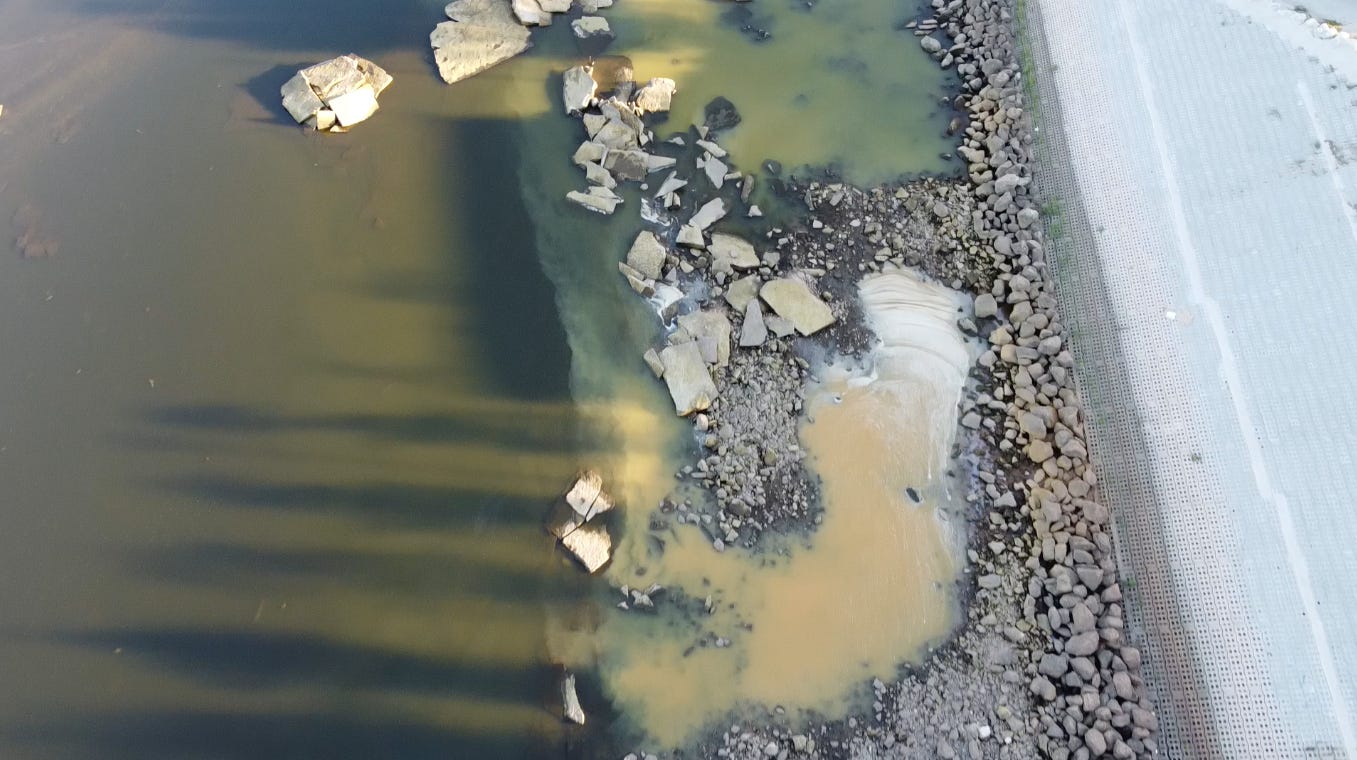
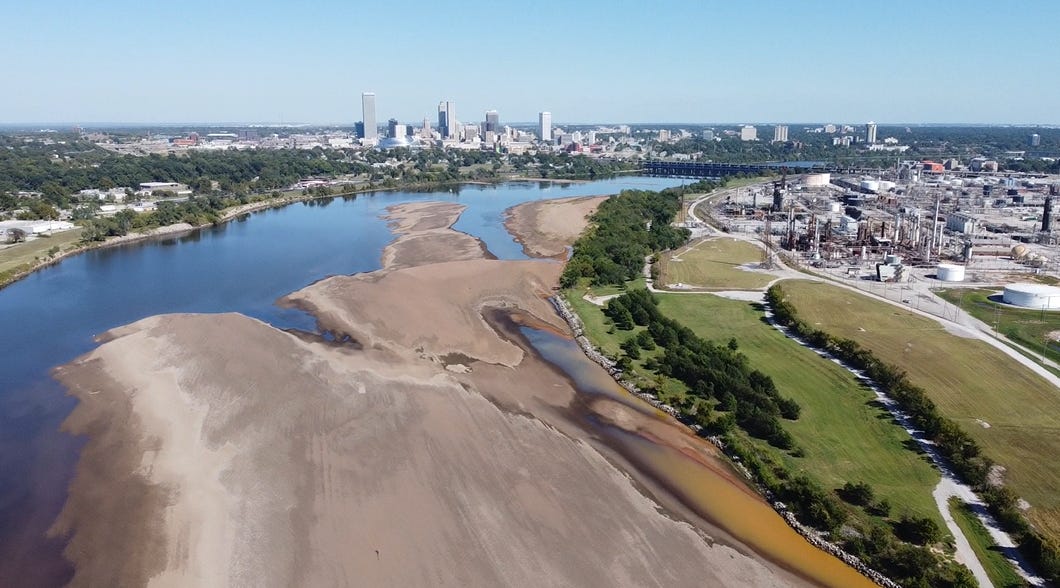
Plumes of discolored water mix with the Arkansas River channel at HF Sinclair’s south containment cap, opposite Gathering Place at the west end of Zink Dam. Sept. 26, 2024.
Geologist and environmental consultant Guy de Verges said he spent about 10 minutes at the cap that evening and left with a headache that lasted the rest of the night.
De Verges, who has worked with industrial operators in the West Tulsa area for more than 30 years, said he recognized the odor from his work excavating and remediating underground storage tanks at gas stations.
He sent me a series of text messages during his visit to the site:
Definitely aging hydrocarbons. I know the smell very well. This is a serious problem. …
This needs to be sampled and eliminated immediately. …
Smell is overwhelming. It is groundwater mixed with old hydrocarbons. Has a very distinctive smell.
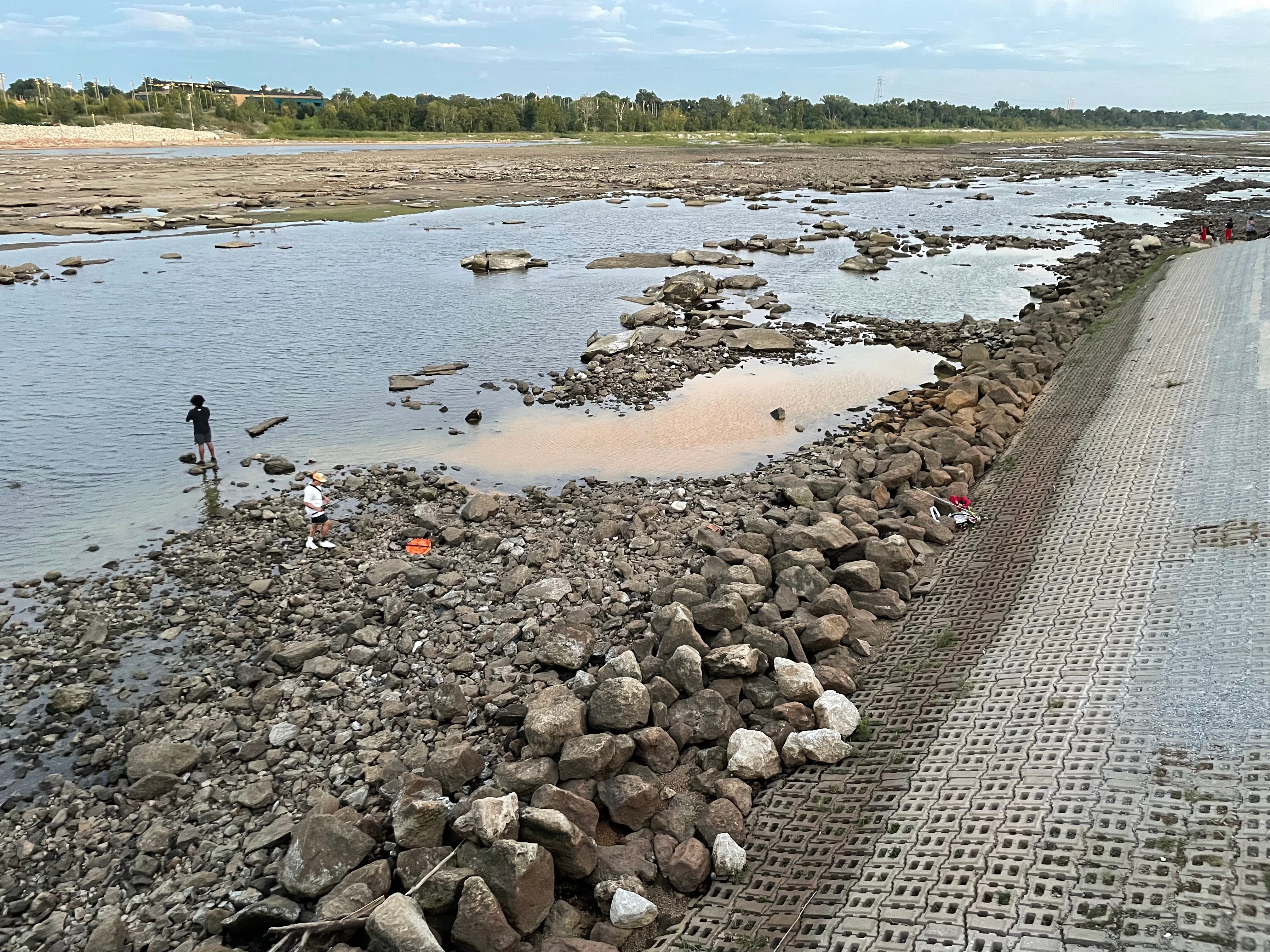
De Verges sent a photo of two anglers. One stood where the orange plume was mixing visibly with the channel. The other was nearby, among the rocks where the site drains to the river. Three more people were visible at the far end of the cap.
“People fishing right there,” de Verges wrote. “This should not be happening.”
I posted about the site on social media and in Watershed Notes2 later that night as Kane’s footage began circulating widely.
Sept. 12, I made it to the toe of the south containment cap, where the smell was overpowering. I could not breathe comfortably even with a mask and a spare T-shirt bunched up over my nose and mouth.
That day, the City of Tulsa and River Parks Authority began responding to social media activity about the pollution with a statement that “City of Tulsa environmentalists” completed an investigation along the west bank of Zink Lake on Sept. 12 and “found no signs of petroleum or hydrocarbons on or in the water”—
A sheen created by iron oxidizing normal bacteria, which is found in many local streams and lakes, was present, which can create a film and turn water a rust color. This normal and natural occurring phenomenon occurs when oxygen, water, and iron combine. … Water samples will continue to be taken at the site and water condition indicators can be found at www.cityoftulsa.org/zink.3
The city also noted that HF Sinclair “conducted its own investigation and confirmed its containment cap was working as designed.”
The statement did not address the odor, cite test results, specify the location of concern or disclose known soil and groundwater contamination in the area. It also ignored the documented, ongoing flow of hydrocarbons into Zink Lake upstream at the HF Sinclair West refinery.4
I shared the city’s statement with de Verges in a series of text messages the same day.
“The smell is not due to natural bacterial growth,” de Verges replied. “This is a typical reaction from the city. Yes there can [be] orange groundwater discharge[s] that are not due to pollution but not the smell. That is a very characteristic smell. Unfortunately that may be the end of it.”
The next day, Public Radio Tulsa ran the city’s statement in full, reporting that the footage from the site was “not what it seems to be” and “not of a pollution emergency but of a naturally occurring process.”
Tulsa World seemed to lose the thread entirely, reporting that a “foamy brown sheen [not the subject of the complaints] on the surface of Zink Lake [not the area below the dam] on Friday [presumably Sept. 13, three days after I reported the pollution to the city] was the result of a naturally occurring phenomenon and does not indicate the presence of petroleum or hydrocarbons.”
In addition to images of scum on the lake, the story featured a video of a tranquil, scum-free sunset paddle, captioned, “Take a trip on Zink Lake … .”5
I returned to the cap that evening with Colby DeWeese, a chemical engineer with experience responding to petrochemical spills. DeWeese previously worked as a process safety engineer for Marathon Petroleum Corporation, where he oversaw verification and measurement of spills, led incident investigations and reported to oversight agencies.
DeWeese spent more than half an hour among the rocks at the base of the cap, examining pools of various colors and textures. As we headed back across the bridge, he expressed dismay at the city’s denial of “very obvious” pollution at the site and lack of regard for public health and the environment.
“Anybody that's done any environmental testing or any incident response in their life would immediately know the smell is hydrocarbon,” DeWeese said.
We debriefed by text message later that evening.
“So painfully obvious it’s hydrocarbon,” he said. “It’s mind boggling to me. If this were an oil and gas facility and I called this level of contamination in [at] their retention pond, or even if it was a pipeline running through a farmer’s yard with a leak and he called it in, the issue would cause people to be working 24/7 until everything was fully contained and mitigated. I can’t even tell you how many after work hours calls I had to take for releases way smaller than this.”
Sept. 14, I posted about the pollution again on social media and in Watershed Notes.
The Arkansas River at HF Sinclair’s south containment cap. Footage from Sept. 9, 2024 by Tulsa resident Daniel Kane and Sept. 13 by Molly Bullock. Video posted Sept. 14 to social media and Watershed Notes.
The following day, River Parks Authority posted a video of the whitewater flume with the caption, “Surf’s up Tulsa! Tulsa Wave Park at Zink Lake is making waves with everyone that visits!”
The flume is located in front of Gathering Place, directly across the bridge from the south containment cap.
In a comment on the Facebook post, Tulsa resident Amber Whitlatch asked whether the plan was to ignore the ongoing pollution.
River Parks Authority replied that the site “was examined and tested” by the city and “determined to be natural occurrence.”
“City of Tulsa environmental staff tested the specific area she is referring to and concluded it was not a spill,” the agency wrote, alluding to my notices about the site.
“And how soon will it be tested again?” Whitlatch asked.
“Please share the details from that investigation here for clarity,” I replied to River Parks Authority on Sept. 16.
“For clarity, City of Tulsa Environmental staff conducted the inspection,” the agency replied. “You can address further inquiries to them.”
I later learned that the city sampled the site just once to test for Total Petroleum Hydrocarbons (TPH)6 and did not wait for the results before announcing that officials “found no signs of petroleum or hydrocarbons on or in the water.”
The city collected the sample Sept. 10 at 9:28 a.m., with the westernmost gate of Zink Dam open, flushing the site with water from upstream. Images provided by a Watershed reader show that much of the area of concern was submerged at the time.
Operations Manager Scott Van Loo said the results, received Sept. 18, were below the test’s detection threshold.
Although the city’s Sept. 12 statement also alleged that the site’s appearance was due to “iron oxidizing normal bacteria,” the city first sampled the site for iron-related bacteria on Sept. 13, and again Sept. 18.
Van Loo said the results, received Oct. 2, were “not conclusive with no confidence in the results.”7
“I want to remind you that DEQ conducted the actual investigation, which I have yet to receive the report,” Van Loo added, in an apparent deviation from the city’s Sept. 12 statement.

Oct. 11, I sent the City of Tulsa, River Parks Authority, DEQ and Muscogee Nation lab results for samples of fluid exiting the bank at the south containment cap. The analysis showed benzene—a carcinogen—and other hazards consistent with known soil and groundwater contamination in the area.8
I later received a notice that DEQ was closing my Sept. 10 complaint. Dated Oct. 10, the letter was signed by Mike Schornick, who oversees the refineries’ hazardous waste management permits.
Schornick wrote that “no hydrocarbon sheening was observed, and no hydrocarbon odors were detected” by DEQ personnel at the site on two dates in September.
The letter did not disclose DEQ investigator Amber Keller’s report of a “strong odor of petroleum” and a sheen that “appeared to be hydrocarbons” on Sept. 10.
DEQ closed the investigation for the September complaints without conducting any environmental testing at the site.9
In a phone interview Oct. 29, Schornick said the test results identifying benzene and other hazards were “unusable” because they did not identify the sampler by name or provide documentation of field work at the site.
Schornick said he did not follow up about the test results because no one asked him to and he “had no reason to do so.”10
I shared Schornick’s statements with the consultant who sampled the site.
“The point of collecting the data is not to do DEQ’s job for them,” the consultant said on a phone call. “The point was to identify the issue. … They still now have to follow up and validate the tests with their own tests. That, to me, would be the reasonable thing to do, since we’ve told them exactly where the problem was and what was found, and what analysis got the results.”
The consultant added that a field report is the kind of documentation they would produce for a customer.
“We used the bottles that were provided by the laboratory,” they said. “And [the lab report] says how they were collected; it was a hand grab sample.11 And that is typical. … I’m not asking for them to use it. We've just identified a problem. Now it's up to them to go in and investigate.”
No one at the City of Tulsa acknowledged or downloaded the test results, so I followed up with Scott Van Loo on Oct. 15.12
Van Loo replied the next day:
Molly
Your email indicates that Holly [HF Sinclair] has an issue. Therefore, I recommend you contact DEQ with your concerns. As we have stated in previous emails, Holly is outside the city limits and does not discharge into Tulsa’s MS4. Tulsa has no authority with this issue.13
TTCU Tulsa Run participants pass HF Sinclair’s south containment cap on Oct. 26, 2024, as plumes of discolored water mix with the Arkansas River channel at the west end of Zink Dam. The City of Tulsa, River Parks Authority and DEQ were notified of test results identifying hydrocarbon pollution at the site on Oct. 11.
Oct. 26, TTCU Tulsa Run routed participants in the 15K across the pedestrian bridge and past the south containment cap. Race organizers did not respond to questions about the observable pollution at the site.
Six months after the initial complaints, the area remains open to the public, with no communication from the City of Tulsa, River Parks Authority, HF Sinclair or DEQ to warn park users of potential exposure to toxic waste at the site.
Most Tulsans still don’t have this information.
Sharing Watershed with your community and supporting our work can change that. If you have the means, help us reach a wider audience with deeply researched, essential reporting:
Subscribe for $7/month or $64/year.
Make a sustaining contribution at a higher level of your choice (choose Critical Mass and enter any amount above $64).
Purchase a gift or group subscription.
All free and paid subscribers get the latest updates delivered to your inbox, plus access to the full archive at mollybullock.substack.com. You can modify your subscription or cancel any time by logging in to your account.
Previously:
If you’re new to Watershed, start at the beginning:
Caplan|Cobb provides pro bono legal support to Watershed in collaboration with ProJourn: a program of Reporters Committee for Freedom of the Press.
I reported the pollution to Oklahoma Department of Environmental Quality [DEQ], EPA, HF Sinclair, the City of Tulsa, River Parks Authority and others in the early hours of Sept. 10.
That evening, Daniel Kane also submitted a complaint about the pollution to DEQ. A third individual submitted a complaint to DEQ on Friday, Sept. 13.
If you’re jumping into the series here, go back to article 12, “A Strong Odor of Petroleum.”
Free and paid Watershed subscribers who have the Substack app receive a notification when I share a new note. Notes are archived under my writer profile; they do not go out by email or appear on the Watershed homepage.
The city’s website does not acknowledge the investigation or provide data from the site.
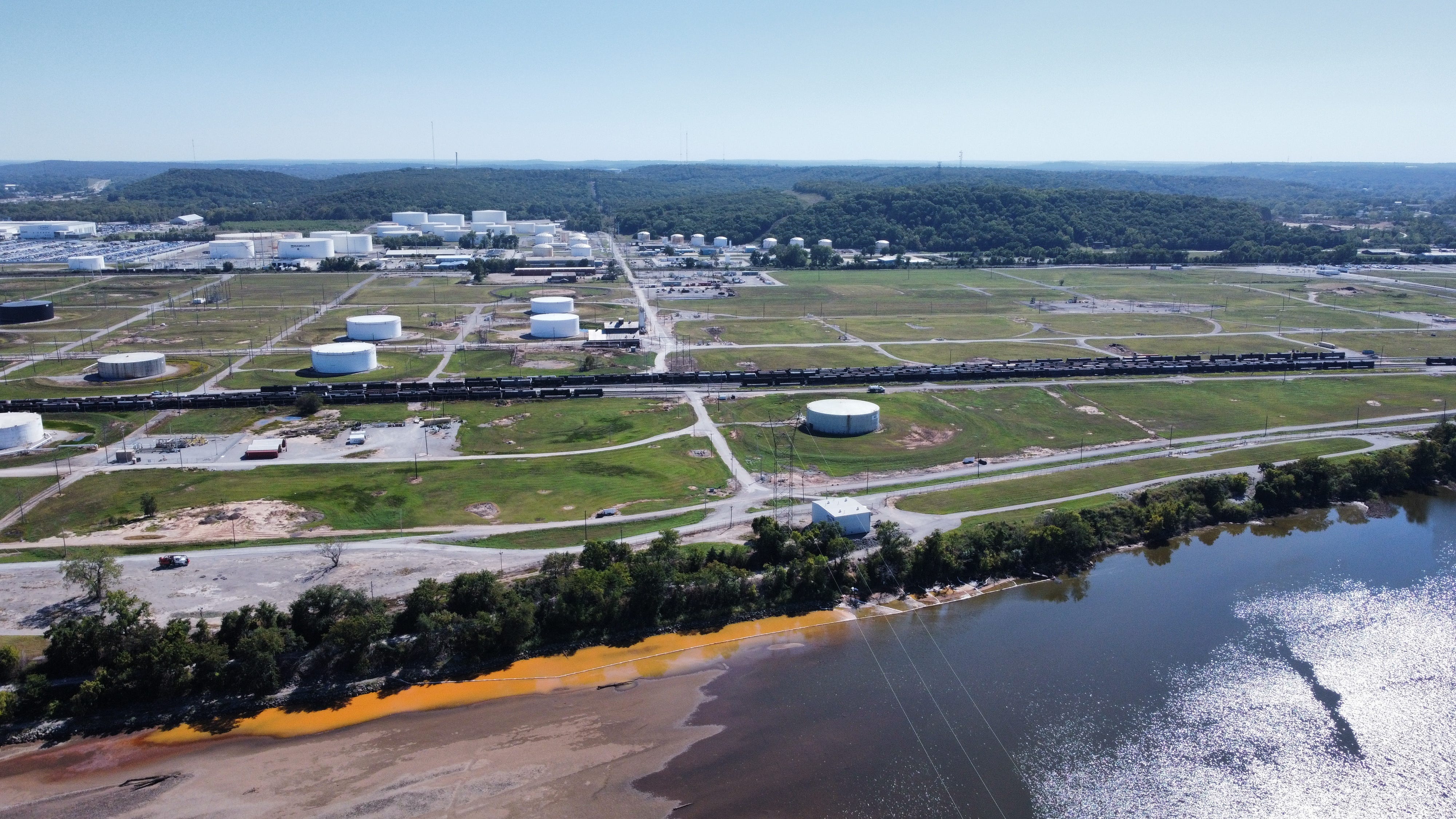
HF Sinclair currently uses floating barriers called booms to limit the appearance of hydrocarbon sheens from the West refinery. However, at a May 22, 2024 meeting, a representative of HF Sinclair said the corporation does not test the Arkansas River to assess the extent of the pollution.
A third outlet, KJRH, interviewed a somewhat skeptical angler fishing at the site to counter the city’s statement.
Total Petroleum Hydrocarbons (TPH) is a general way to detect the presence of hydrocarbons found in crude oil.
On a phone call in July, geologist and environmental consultant Guy de Verges said the test “just kind of scrapes the surface” of a long list of potential chemicals and other pollutants in the Zink Lake area.
On a call in October, de Verges said the city’s TPH detection limit—the lowest concentration the test can pick up—is “not nearly low enough” to produce a meaningful understanding of the ongoing pollution at the west end of Zink Dam.
The city’s TPH detection limit of 4.55 milligrams per liter is 910 times less sensitive than the independent testing that later identified benzene and other hazards at the site.
In a Jan. 30 meeting at City Hall, Van Loo said the results were inconclusive because the iron-related bacteria test used was “for oilfield applications and not really the application associated with what we had.”
I have not pursued Van Loo’s comment further.
An expert environmental consultant collected samples at the site and paid for analysis at an environmental testing laboratory accredited by DEQ. I will address the results in greater detail in an upcoming article.
On a phone call Oct. 24, I described conditions at the site to DEQ Communications Director Erin Hatfield and inquired about re-reporting the pollution given the closed complaints.
Later that day, Hatfield texted me the DEQ hotline number I used to file my initial complaint. Hatfield wrote that if I called the hotline again, DEQ would try to coordinate “going with us on the investigation.”
Given DEQ’s handling of the first investigation, I contacted EPA Region 6 for guidance on alternate channels for reporting the pollution.
The response from Press Officer Joe Robledo appeared to confuse the locations and details of containment measures at the two HF Sinclair Tulsa refineries.
Robledo offered no alternatives to address concerns about the pollution from the East refinery.
“EPA will continue to offer ODEQ support in their inspections/investigations,” Robledo said in an email Nov. 21. “Please continue your correspondence with ODEQ, the lead environmental agency on this matter.”
After multiple requests to clarify his statements and provide alternative guidance, Robledo said in a Jan. 15 email that “EPA does not have any additional information on this topic.”
Feb. 25, in a period of significantly lower water during repairs to Zink Dam, I filed new complaints with EPA’s National Response Center and the DEQ hotline.
Hatfield called Feb. 27 to let me know DEQ was working to coordinate schedules for a site visit the following week.
March 3, Hatfield emailed to confirm my attendance at a site visit on Friday, March 7. I will share details from the visit in an upcoming article.
I will share more of my interview with Schornick and address DEQ’s failure to fully investigate the initial complaints in an upcoming article.
The consultant added that “the water went directly into the sample bottles, and [they] were immediately sealed, chilled, and delivered to the lab.” I will describe their account of the sampling process in greater detail in an upcoming article.
I shared the test results with then-Mayor G.T. Bynum, Scott Van Loo, and city Communications Director Michelle Brooks.
It was unclear what previous emails Van Loo meant to reference; I do not recall receiving any emails from Brooks or Van Loo about the refinery’s location in unincorporated Tulsa County and Tulsa’s municipal stormwater permit (MS4), certainly not in reference to the ongoing pollution.
Having worked with USTs as well, when your friend was talking about that distinct smell, it brought back a lot of memories. Woof. I can't imagine how bad it was right there. What a dereliction of duty for so many agencies. I wonder how many campaign donations have gone to the right people in the city/county/state agencies that came from that facility and their ownership? What about posting guerilla signs about the contamination? It would at least cause public outrage and push the issue?
Is it going to take a disaster to bring the proper attention to the hydrocarbon pollution in the river? You have provided multiple opportunities for the City of Tulsa, EPA, DEQ, River Parks Authority to take action, but it is obvious that your efforts are being stonewalled. It’s irresponsible and disgraceful.